


Ask most people to picture a spinning wheel and they'll think of a game show or a carnival, not a classroom. But educators have quietly discovered that the same simple mechanic — options on a wheel, a spin, a random result — is a surprisingly effective teaching tool. The randomness that makes a wheel fun is exactly what makes it useful for learning.
Why randomness helps learning
At the heart of it is engagement. A predictable classroom is an easy one to tune out of; students who know they won't be called on stop paying attention. Introduce a random element and that changes. When anyone might be picked at any moment, everyone stays a little more alert. The spin creates a low-level anticipation that keeps a room switched on without the teacher having to raise their voice or crack down.
There's also a fairness dimension that matters educationally. Learning happens through participation, and participation that's distributed randomly reaches the students who'd otherwise coast in silence. A wheel gently pulls in the quiet ones and stops the confident few from dominating, which spreads the actual cognitive work of a lesson across the whole class rather than concentrating it in a handful of eager hands.
The many classroom uses
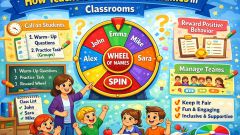
Educational spin wheels are remarkably flexible. Loaded with student names, a wheel becomes a fair way to cold-call, form groups, or assign roles — the wheel of names handles all of that with a single list. Loaded with content instead, it becomes a review game: put vocabulary words, math problems, discussion questions, or historical dates on the wheel and spin to decide what the class tackles next. The unpredictability turns rote review into something closer to a game show, which is a far easier sell to a tired afternoon class.
Number-based wheels open up math practice specifically. Spin two numbers and have students operate on them, or use a number wheel to pick which problem to solve. The randomness removes the sense that the teacher is targeting anyone and adds a bit of play to drills that would otherwise feel like a slog.
Building emotional and social skills
Wheels aren't only for academic content. Teachers use them to support social-emotional learning too — spinning a feeling and discussing it, or using a wheel to decide who shares in a morning circle. The randomness lowers the stakes of participation, which helps anxious students engage with topics they might otherwise avoid. A tool that makes it feel like chance rather than exposure can be the difference between a quiet child speaking up and staying silent. Over a school year, those small moments of low-risk participation accumulate into real confidence, and a student who first spoke up only because the wheel picked them often becomes one who volunteers on their own.
Why it works better than it should
The interesting thing about educational spin wheels is how much they achieve for how little they cost. There's no complex technology, no training, no expense — just a list and a spin. Yet the effect on a room is real: more even participation, higher alertness, less friction around selection, and a bit of genuine fun woven into routine tasks. It works because it aligns with how attention and motivation actually function. We pay more attention to uncertain outcomes, we trust visibly fair processes, and we engage more when there's a small element of play. A wheel taps all three at once.
It also connects to the broader psychology of decision-making, where a random prompt can cut through hesitation — an idea we explore in our guide to mastering the yes or no wheel. Educators have simply pointed that same pull toward learning.
Getting the most from them
The teachers who benefit most treat the wheel as one tool among many, not a replacement for judgment. It's brilliant for fair distribution and engagement, but a good educator still knows when to override it — to support a struggling student, to follow a productive tangent, to make a deliberate choice the moment calls for. Used with that balance, and kept visible and consistent so students come to trust it, an educational spin wheel becomes a small but genuine multiplier for the energy and equity of a classroom.
The takeaway is simple: a mechanic we associate with games turns out to serve learning remarkably well, precisely because good learning and good games share more than we usually admit. Both thrive on engagement, fairness, and a little suspense — and a spinning wheel delivers all three from nothing more than a list and a click. It's worth noting how well this scales across ages and subjects. A kindergarten teacher can spin to decide who feeds the class pet; a high-school chemistry teacher can spin to pick which element a student explains; a language teacher can spin vocabulary for a rapid-fire review. The mechanic doesn't care about the content, which is exactly why it travels so easily from one classroom to the next. And because it costs nothing and needs no setup beyond a list, there's no barrier to trying it — a teacher can introduce a wheel on a whim during one lesson and keep it only if it earns its place. In practice, most who try it do keep it, because the payoff in participation and energy is immediate and obvious the first time a normally silent student lights up at being picked by chance rather than singled out.