

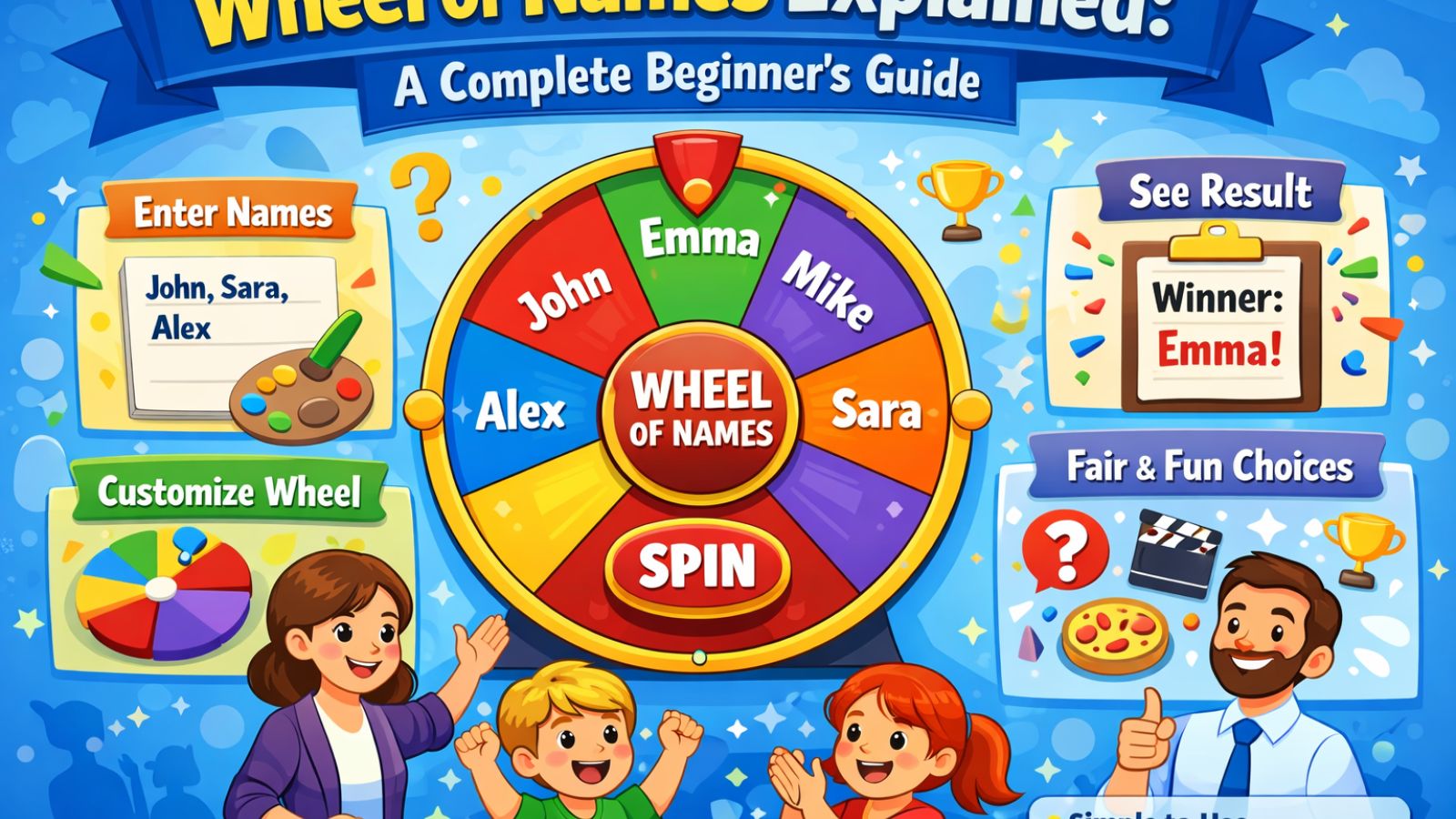
A wheel of names looks almost too simple to explain — you spin it, it stops, you get a name. But there's a small amount of genuinely clever design behind that smooth animation, and understanding it helps explain why the tool feels so trustworthy. Here's what's actually happening when you hit spin.
The list becomes the wheel
It starts with your list. Every name you enter is assigned an equal slice of the circle. Twelve names means twelve equal segments; fifty names means fifty thinner ones. This equal division is the foundation of the whole thing — because every slice is the same size, every name occupies the same share of the wheel, and therefore has the same chance of being landed on. If you've used the name picker wheel, you've seen this happen automatically the moment you add or remove an entry.
The spin is decided before it finishes
Here's the part that surprises people: the winner is essentially chosen at the moment you click, not when the wheel visually stops. Under the hood, the tool calls a random number generator, picks a result, and then animates the wheel so that it decelerates and comes to rest on that predetermined outcome. The spinning you watch is a presentation layer — a way of turning an instant, invisible calculation into something that feels physical and fair.
That might sound like the animation is "fake," but it's the opposite. The result is real and random; the animation simply makes it visible. A raw line of text saying "the winner is Sarah" would be just as random, but it wouldn't carry the same sense of an honest, watchable draw. The spin exists to build trust, not to determine the outcome.
What "random" really means here
The randomness comes from a pseudo-random number generator, the same kind of tool that powers everything from video games to simulations. For the purposes of picking a name, it's random in every way that matters: the outcome is unpredictable, there's no detectable pattern across spins, and no name is favored over another. Each spin is also independent — the wheel has no memory, so a name that just won is exactly as likely to win again on the next spin, unless you turn on the option to remove picked names.
This independence is worth sitting with, because it's a common point of confusion. People sometimes expect the wheel to "spread out" its picks so everyone gets a turn. It doesn't, by default. True randomness includes streaks and repeats — flip a coin ten times and you'll often see three or four heads in a row, and a wheel is no different. If you want guaranteed no-repeats, that's a separate feature — the remove-on-pick setting — layered on top of the random draw, and it's worth turning on whenever you're drawing an order or several unique winners rather than a single pick.
Why the fairness holds up
The reason a wheel of names is trusted for raffles, classrooms, and giveaways comes down to two things working together: equal slices and an unbiased draw. The equal slices guarantee equal probability. The random generator guarantees the selection can't be predicted or nudged. Neither the person running it nor anyone watching can influence where the pointer lands. That's a stronger guarantee of fairness than almost any manual method, and it's fully visible, which manual methods never are.
Contrast that with a teacher picking "randomly" from memory, which is subtly shaped by attention and habit, or a raffle drawn from a spreadsheet the audience can't see. The wheel's fairness is both real and demonstrable, and the demonstrable part is what makes people accept the result without argument.
Adding your own rules
Most wheels let you shape the behavior around that core draw. The most common addition is removing a name after it's chosen, which converts the tool from "pick one" into "draw an order" or "pick several unique winners." Some let you weight entries, save lists between sessions, or adjust the animation speed and sound. None of these change the underlying fairness of a single spin — they just adapt the tool to different jobs, from a quick classroom cold-call to a formal prize draw with hundreds of entrants where a clean, unrepeatable sequence matters.
Teachers in particular tend to build small routines around it, which we explore in our piece on how teachers use a wheel of names in classrooms. The mechanics stay identical; what changes is how the fairness gets put to work.
The short version
A wheel of names divides your list into equal slices, uses a random number generator to pick a winner the instant you spin, and then animates the wheel to land on that result so the whole draw is visible and believable. The cleverness isn't in complicated math — it's in wrapping a genuinely fair, unpredictable selection inside something anyone can watch and trust. That combination of real randomness and visible fairness is the entire reason the tool works. It's also why a wheel of names has outlasted countless flashier apps: the core function is honest and easy to trust, and trust is the whole product. Once you understand that the animation is a presentation of a real random draw rather than the draw itself, the tool stops feeling like magic and starts feeling like what it is — a fair coin flip scaled up to any number of options, dressed in something you can actually watch. That's a small piece of design cleverness doing a surprisingly big job.