

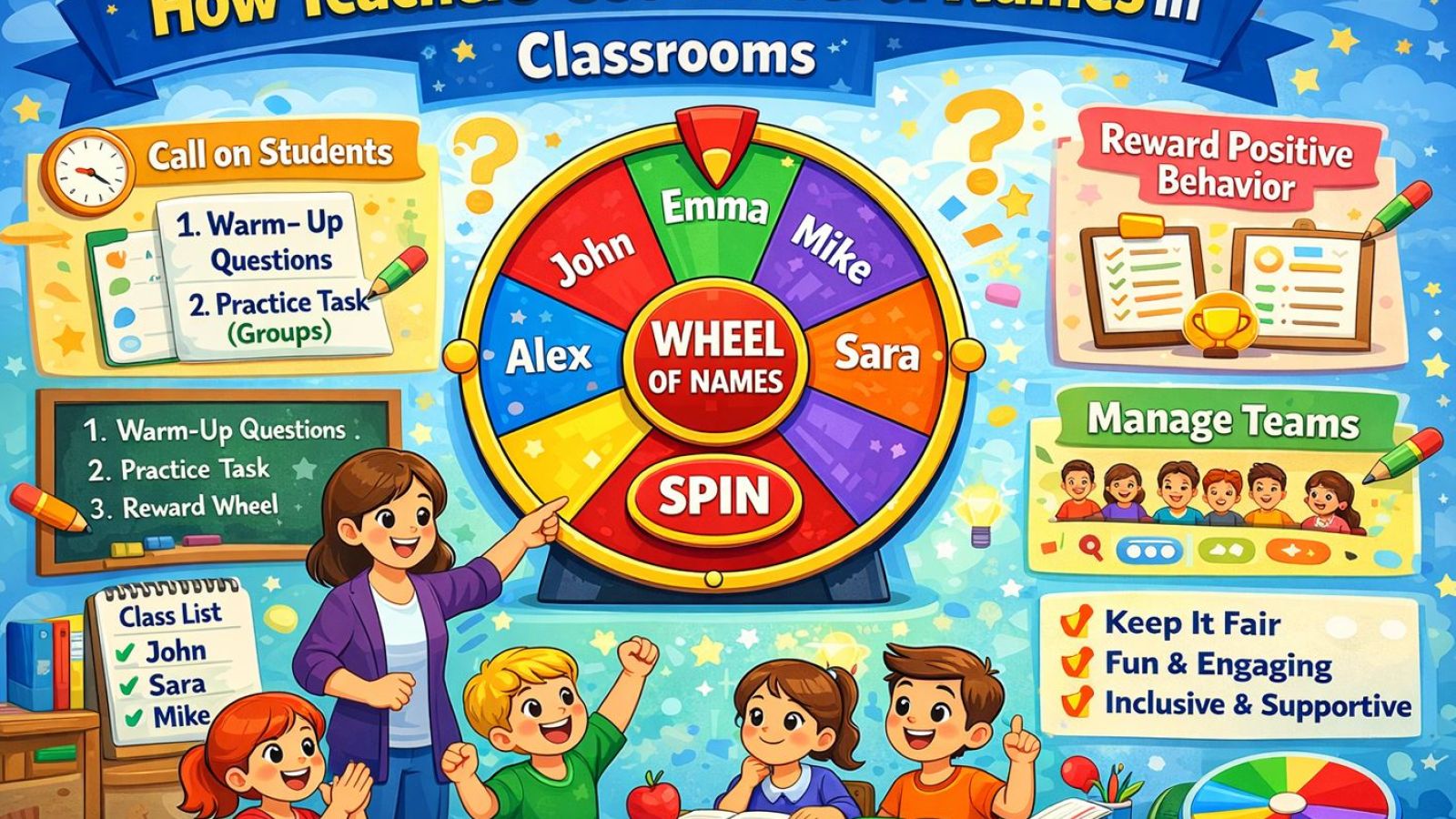
Walk into a classroom that uses a wheel of names and you'll notice something within a few minutes: participation is spread out, and nobody flinches when they get picked. That's not an accident. Teachers have quietly turned this simple spinner into one of the most versatile tools in the room, and the ways they use it go well beyond just deciding who answers the next question.
Cold-calling without the bias
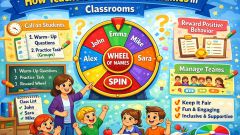
The most obvious use is cold-calling — picking a student to answer without them volunteering. Done from memory, this is quietly unfair: teachers gravitate toward the confident hands and the front rows, and the quiet students slip through the cracks for weeks. A wheel removes that drift entirely. Load the roster, spin, and every student has the same odds every single time. You can set up a fresh wheel of names with your class list in under a minute, and from then on the fairness runs itself.
Crucially, students can see the wheel is impartial, which changes how being picked feels. It stops registering as "the teacher chose me" and starts feeling like luck of the draw, which lowers the anxiety that makes shy kids dread cold-calling in the first place.
Forming groups and pairs
Letting students pick their own groups is a social minefield — someone always ends up left out, and friend clusters reinforce themselves. Assigning groups by hand invites accusations of favoritism. A wheel sidesteps both. Spin repeatedly to draw names into teams, and the groupings are obviously random, so nobody can complain that the teacher stacked the deck or that they got stuck with a particular partner on purpose.
This works especially well for mixing up a class that has settled into cliques. Random pairing forces students to work with people outside their usual circle, which is often exactly the point of group work in the first place. It also spares the teacher from the awkward job of manually splitting up best friends who chatter, or rescuing the student nobody picks — the wheel does the socially difficult part invisibly, so no one feels targeted or left out when the groups come together.
Distributing classroom jobs
Every classroom has a set of roles — line leader, board cleaner, materials monitor, the coveted and the tedious alike. Handing these out fairly by memory is nearly impossible, and students keep a close mental tally of who got the good jobs. A wheel makes the distribution visibly random. When the popular role goes to someone by spin, there's no favoritism to resent, and when the dull job lands, there's no one to blame.
The same logic covers turns and order — presentations, reading aloud, choosing a book, going first in a game. A wheel settles all the small ordering questions that would otherwise spark debate. Instead of "who wants to go first" (silence) or the teacher picking (grumbling), a spin decides instantly and neutrally. Over a term, removing these tiny friction points adds up to a smoother-running room and a lot less low-level negotiation.
Building engagement and energy
There's a subtler benefit that experienced teachers notice: the wheel adds a little theater. The spin creates a beat of suspense, and students lean in to see where it stops. That small game-like moment keeps attention up, particularly with younger classes who respond to the element of chance. It reframes a routine mechanic as something with a bit of fun in it, without any extra effort from the teacher.
Using it wisely, not blindly
The best teachers treat the wheel as a default, not a rule. There are moments to override it — to gently pull back a student who's drifted, to hand an answerable question to a struggling kid, to build a nervous student's confidence. Skilled teaching blends random fairness with deliberate intention, and because nobody can tell which picks were which, the intentional ones never look like singling anyone out. Many teachers also enable the remove-after-pick option so that across a lesson, everyone gets a turn before anyone repeats — a small tweak that fits the classroom's need for coverage.
Understanding why the tool is reliably fair helps too, especially if a skeptical student pushes back. Our explainer on what a wheel of names is lays out the basics of how it guarantees everyone an equal chance, which is worth being able to articulate when a class asks whether it's really random.
The bottom line for teachers
A wheel of names earns its place not because it does anything a teacher couldn't do manually, but because it does those things fairly, visibly, and instantly. It removes unconscious bias from selection, defuses the social tension around groups and jobs, and adds a spark of engagement, all from a tool that takes seconds to set up. For something so simple, it changes the feel of a room more than you'd expect — and it's free to try for a single lesson to see whether your class responds the way so many others have. Perhaps the most telling sign of how well it works is how quickly students start expecting it: once a class knows the wheel is how selection happens, they stop watching to see whether the teacher will pick a favorite and simply accept that anyone might be next. That shift, from suspicion to shared expectation, is the quiet foundation that better participation gets built on, and it arrives with almost no effort on the teacher's part beyond keeping the roster loaded and spinning when it's time.