

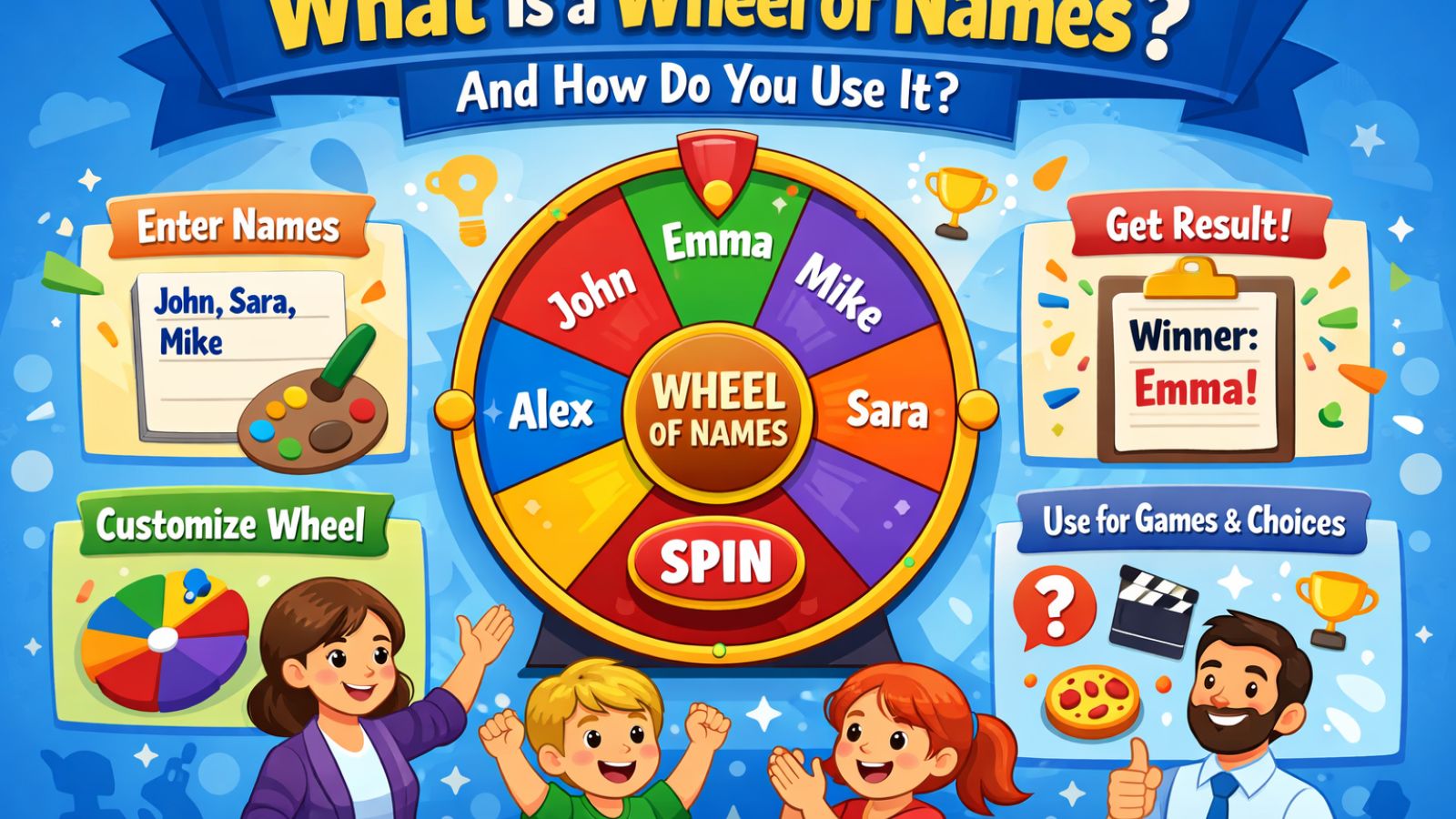
If you've ever needed to choose one person from a group and wanted it to feel genuinely fair, you've run into the exact problem a wheel of names solves. It's a simple idea: you type in a list of names, the wheel spins, and it lands on one at random. That's the whole tool. But the reasons it works so well, and the situations it quietly improves, are worth unpacking.
The basic idea
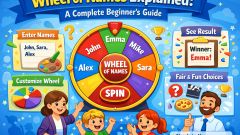
A wheel of names is a digital version of the old spinning prize wheel you'd see at a carnival, except instead of dollar amounts or prizes, each slice holds a name. You add as many names as you like — a handful or a hundred — and each one gets its own segment. When you spin, the wheel decelerates and stops with a pointer resting on a single name. That name is the pick.
There's nothing more to it on the surface, and that simplicity is the point. It doesn't require accounts, it doesn't need setup beyond typing your list, and anyone watching can immediately see how it works. You can try it yourself with the wheel of names and have a working spinner in under a minute.
Why not just pick by hand?
The obvious question is why bother with a tool at all. Can't you just pick someone? You can, but people are surprisingly bad at being random, and worse at appearing fair while doing it. When a teacher "randomly" calls on a student, they unconsciously favor the eager hands near the front, or the same reliable few, or avoid the kid who looked away. None of that is malicious — it's just how human attention works. But the students notice, and over time it erodes trust.
A wheel removes all of that. It has no memory of who it picked last time, no preference for the front row, no awareness of who's raising a hand. Everyone on the list has precisely the same chance, and just as importantly, everyone can see that they do. That visible fairness is often more valuable than the randomness itself.
How the randomness actually works
Behind the animation, a wheel of names uses a random number generator to decide where the pointer stops. The spinning graphic is really just a friendly way of presenting that result — it makes an invisible calculation feel tangible and fair. If you're curious about the mechanics in more depth, the difference between the animation and the underlying draw is genuinely interesting, and it comes down to a random number generator doing the real work behind the scenes.
The key thing to understand is that the outcome is genuinely unpredictable. There's no pattern, no way to game it, and no hidden weighting unless you deliberately add one. Each spin is independent of the last, which is exactly what you want when the whole point is fairness.
Where people actually use it
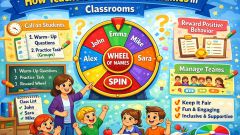
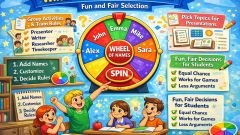
The most common home for a wheel of names is the classroom, where teachers use it to cold-call students, assign groups, pick who presents first, or hand out classroom jobs. It turns a potentially awkward moment into a neutral, almost game-like one, and it takes the pressure off the teacher to seem impartial because the tool obviously is.
Beyond school, it's a fixture of giveaways and raffles. Anyone running a prize draw — a small business, a streamer, an event host — needs a way to pick a winner that the audience will accept as legitimate. A visible spin does that far better than announcing a name off a spreadsheet nobody else can see. It's also a quiet workhorse at home and in offices for settling the small stuff: who does the chore, who goes first, who has to make the awkward call.
Making it your own
Most wheels let you do more than just spin a fixed list. You can usually remove a name once it's been picked, which is handy when you're drawing several winners and don't want repeats. You can add or delete names on the fly, save a list so a class roster or regular team stays loaded, and adjust the look or sounds to taste. These small touches turn a one-off gimmick into a tool you actually reach for regularly.
For teachers specifically, there's a whole approach built around using a name wheel fairly in a classroom setting, which we cover in our guide to using a wheel of names for students. The core idea stays the same, but the classroom brings its own considerations around participation and equity.
The bigger takeaway
A wheel of names is a small tool that solves a surprisingly universal problem: how do you make a fair choice that everyone trusts? The answer turns out to be less about the math and more about the transparency. When the selection happens out in the open, where everyone can watch it land, the argument about fairness simply disappears. That's why a tool this simple has stuck around and found a home everywhere from primary school classrooms to livestreamed giveaways. Spin it once and the appeal is obvious. What starts as a novelty tends to become a genuine habit, because once you have a fair, frictionless way to make these little choices, you stop wanting to go back to the awkward manual version. The tool is simple, but the problem it solves — making a fair pick everyone believes in — turns out to be everywhere, from the classroom to the boardroom to the family dinner table deciding who does the dishes.